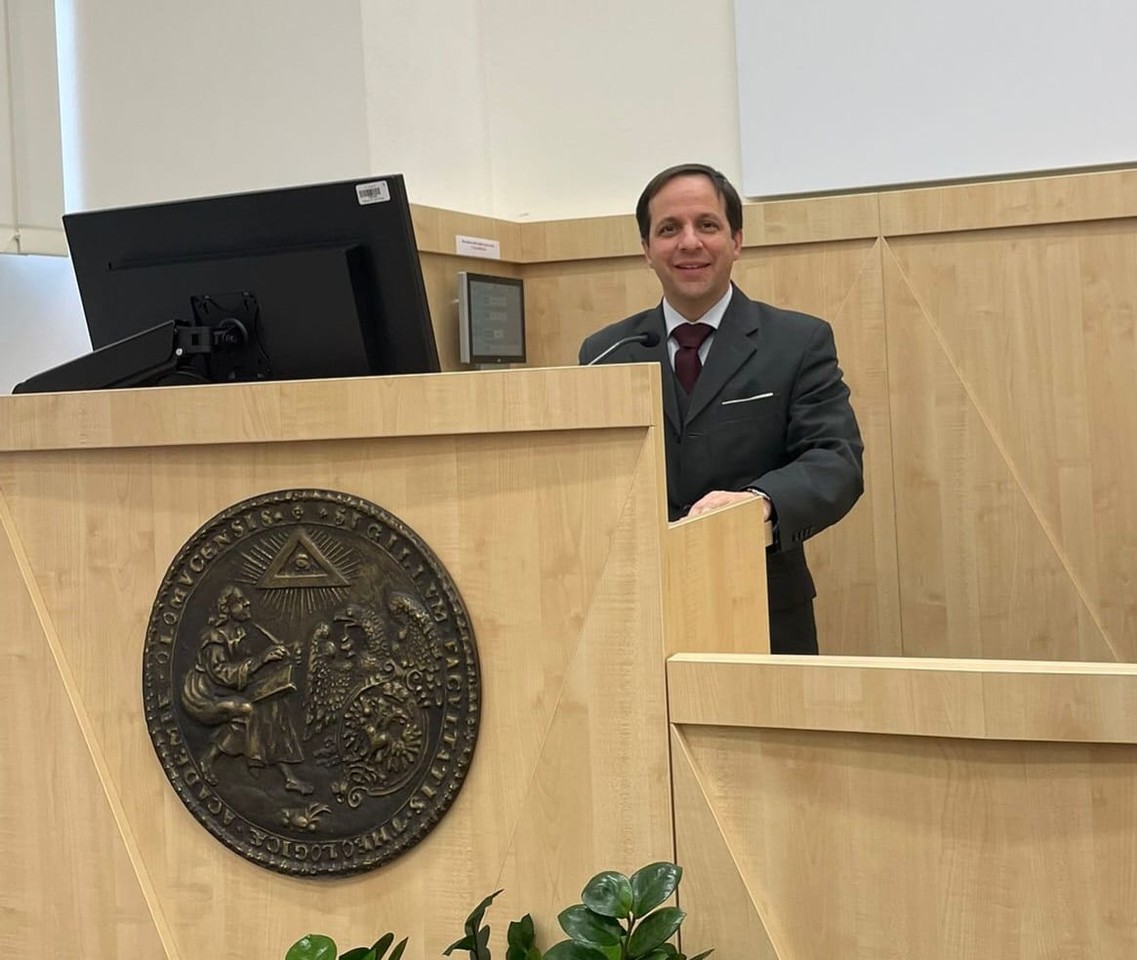
Ambassador Puyana, can peace, dialogue, and trust be taught?
Yes. There are many institutions and universities around the world dedicated to the study of peace, offering degrees and programs in peace and reconciliation. For example, we offer a Higher Diploma in Coexistence jointly with the King Hamad Global Centre for Coexistence and Tolerance, based in Bahrain and Gioya Higher Education in Malta. We also offer master’s programs in religion, culture, and peace studies, organized in cooperation with our partners.
Peace and security are central themes of your work. How should we understand these concepts today?
First, I would say that we do not have a single, universally accepted definition of peace. Peace is defined by its elements. What are the elements of peace? In this sense, we must understand peace and security within the framework of the three pillars of the United Nations: peace and security, human rights, and development. We cannot have peace and development without respect for all human rights.
What is the most important step toward achieving peace?
The most important step is education. Without education, we cannot reach the state of mind and spirit necessary for peace. In this regard, the conference you held here in Olomouc on peace and reconciliation provides a foundation for dialogue. The first step toward dialogue is trust. Without trust, diplomacy cannot function.
Ambassador Puyana, you are an ambassador and permanent observer at the United Nations University for Peace. Could you please describe its role within the United Nations?
The University for Peace was established in 1980 by a General Assembly resolution promoted by the government of Costa Rica. It is a university based in Costa Rica, with students from around the world, and it reports to a governing body composed of 43-member states. Furthermore, it is part of the United Nations family. This means that reports of the University for Peace are presented by the Secretary-General of the UN to the Fourth Committee of the UN General Assembly.
What are the University’s main objectives?
We have two main objectives, in accordance with the charter of the University for Peace. The first is peace education at the level of higher studies. We offer a wide range of master’s degree programs in fields such as diplomacy, conflict resolution, and women, peace, and security. We also offer a PhD program. In parallel, we have received a mandate from the General Assembly to approach security from a different perspective and to use this approach in training, research, and education in order to respond effectively to global threats.
Humanities and peacebuilding
We are here at the Faculty of Theology. Is there a way of learning peace from the perspective of theology and the humanities?
Theology and philosophy can offer many solutions to the current challenges we face regarding peace and security in the world. Conferences such as this one on dialogue and reconciliation are important opportunities to learn from good practices rooted in theological perspectives. We are learning a great deal about how dialogue can be made possible. The perspectives found in papal encyclicals, as well as the work carried out by the Church over the past 2,000 years, are extremely valuable and should be taken into account.
Is peace particularly under threat in our time?
I believe peace has always been a challenge. We must be clear about this: peace and security have been challenges since the beginning of humanity. That said, one of today’s major challenges concerns the multilateral system, particularly the United Nations system. Why? Because we see tendencies among some governments to return to a balance-of-power model and spheres of influence. This approach is incompatible with the principles of the United Nations, which are based on cooperation and dialogue. This tendency represents a major challenge today. However, these political movements have always occurred since the inception of the United Nations in 1945. Nothing is new; only the narrative has changed, and the soft power has lost momentum for the time being. At the same time, the United Nations includes nearly 200 countries, most of which are medium-sized powers with populations under 10 million. These countries need and want to strengthen the multilateral system, because it is the only way for them to have a voice in multilateral decision-making.
Based on your global experience, how do you view the situation in Central Europe?
It is important to highlight the role played by certain Gulf countries in peace negotiations. For example, the United Arab Emirates have played an important role in Abu Dhabi by bringing parties together—in particular, Ukraine and Russia—to discuss aspects of a future peace or at least a ceasefire. It is also critical to focus on the humanitarian consequences of this conflict. At the same time, this conflict will have long-term implications for peace and security in Europe, as well as for future relations between Russia and the European Union.
Mr. Puyana, could you offer some words of encouragement to our students?
First, I would like to send a strong message: you are at one of the most important moments of your lives. You are living in a vibrant cultural environment here in the Czech Republic. At this wonderful university, you have the privilege of learning from excellent and highly respected professors. This is a great opportunity to build the foundations for your future—perhaps one day becoming professors, doctors, diplomats, or civil servants, even at the United Nations.
Mr. Puyana, thank you for the interview.
INFOBOX:
David Fernández Puyana is a Spanish scholar, lawyer, and academic specializing in international law, human rights, and global governance. He serves as Permanent Observer to the United Nations Office in Geneva, Vienna, and UNESCO Paris and has long been involved in issues related to human rights protection, peace, and sustainable development.
He holds a doctorate in international law and actively publishes academic studies focusing on the role of human rights within the United Nations. He collaborates with academic institutions and international organizations and participates in research projects on global ethics, intercultural dialogue, and state responsibility in the field of human rights. He is also the author and editor of a number of publications on the reform of international institutions and the promotion of the right to peace as a fundamental human right. His work combines diplomatic practice with academic research.